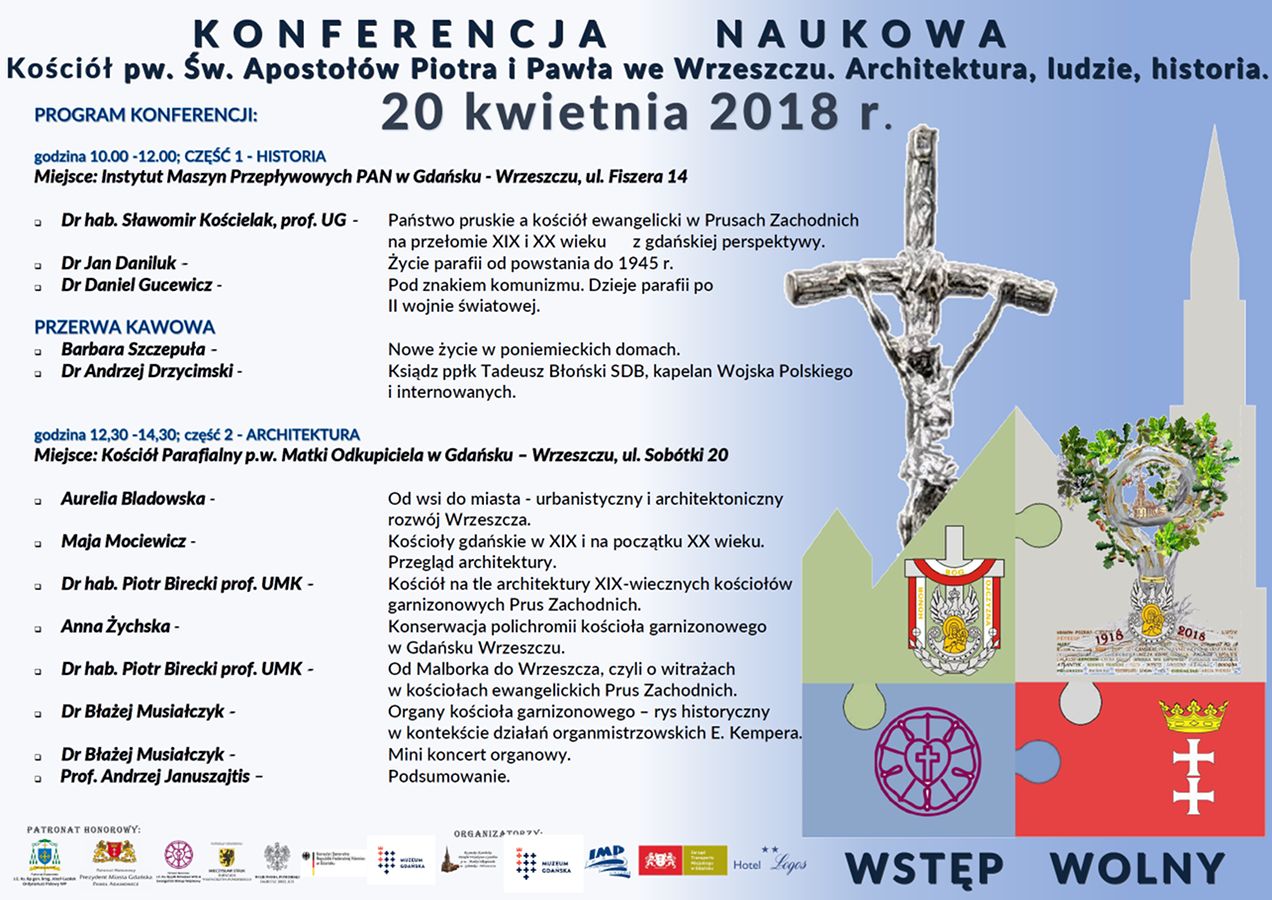
Scientific conference on “The Church of the Apostles Peter and Paul in Wrzeszcz. Architecture, people history". This conference is organized by Fr. kmdr Lt. Sławomir Pałka - parish priest of the Military-civil parish of Mother of the Redeemer in Gdańsk – Wrzeszcz.
The conference has many aims, popularization of unique sacral architecture based on historical knowledge of the construction of Evangelical churches during the late 19th and early 20th centuries, the Gdansk and Kwidzyn district, which administratively included Western Prussia. Further on, the history of the Lutheran Church in Gdańsk Wrzeszcz, a parish of the military Catholic Church since 1945, its enormous influence on the life of Gdańsk and the district of Wrzeszcz (including scientific workers and students of the Gdańsk University of Technology), from the first chaplains working in this temple, the preservation of Polish identity, Catholic and patriotic attitudes and testimonies flowing from this community.
It is also a moment of showing preserved since its construction of the original and historical substance of this church. It is finally an element of the existing and impossible to erase the multireligious and multicultural history of the City of Gdańsk.
In the conference we would like to show, among other things:
- the system of building evangelical churches, i.e. where the Prussian state was the main construction investor and initiator of the development of Lutheran architecture – through the adaptation of stately castles and monasteries to Evangelical churches, and works of prominent German architects of the capital Berlin;
- sources of investment financing through collectors, parish funds, royal and imperial gifts, and the activities of the Prussian settlement commission, and from this origination of the acceptance of neo-Gothics as an optimal building style, which provided funding for the Prussian state, including the equipment of many Evangelical churches, presenting the history of altars, ambon, organs, baptismalians, easel painting, mosaic painting and stained glass. In the case of the imperial patronage, the architectural style in which the Evangelical church was built was an accident of the imperial policy. In the Reich, Wilhelm II saw himself as Frederick I Barbarossa, hence the Neo-Roman architecture reigned here. In Prussia, where the emperor acted as heir to Albrecht Hohenzollern, the last great master and founder of secular Prussia, could only perform neo-Gothic architecture. If the parish community wanted to have a church built in a different style, then it had to finance itself with its own resources;
- identification of stained glass and inscriptions on the bells and their ornamented images as an introduction to the discussion of the participation of Wilhelm II and his wife Auguste Victoria in the foundation process, including specific foundations and their iconography, including e.g. the bell from the church in Gdańsk, which was decorated with images of the great masters of the Teutonic Order;
- Analysis of the patronage activities of the imperial couple. The uprising and activities of Evangelischer Kirchenbauverein, as an association in which architects operating imperial foundations in Prussia operated, based on the presentation of the architecture of the church of St.
- The role of the church after the war and its individual priests in creating a parish community and its impact on the lives of the inhabitants She screams in every dimension.
Conference Honorary Committee:
- JE Bishop Gen. Brigadier General Józef Guzdek Ordinary of the Polish WP,
- JE Fr. Bishop Mirosław Wola Chief Military Chaplain - Evangelical Military Bishop,
- Mrs Cornelia Pieper Consul of the Federal Republic of Germany in Gdansk,
- Mr Mieczysław Struk Marshal of Pomerania,
- Dariusz Drelich of the Pomeranian Voivodeship,
- Mr Paweł Adamowicz President of the City of Gdańsk,
- Prof. Andrzej Januszajtis – b. director of the Institute of Physics PG, distinguished expert, promoter of the history of Gdańsk,
- Professor UG Dr. Waldemar Ossowski Director of the Historical Museum of the City of Gdańsk,
Organizers:
- Military-civil parish of Mother of Redeemer in Gdańsk – Wrzeszcz
- Historical Museum of the City of Gdansk
- Robert Szewalski Institute of Flow Machines Polish Academy of Sciences
Speakers and Topics:
CONFERENCE PROGRAMME | |
10.00 - 12.00; Part 1 - HISTORY | |
Dr. Sławomir Kościelak, Prof. UG | Prussian State and Evangelical Church in Western Prussia at the turn of the 19th and 20th centuries from the Gdańsk perspective |
Dr Jan Daniluk | Life of the parish from the Uprising to 1945. |
Dr Daniel Gucewicz | Under the sign of communism. The history of the parish after World War II. |
Coffee break | |
Barbara Szczepała | A new life in German homes. |
Dr Andrzej Drzycimski | Fr Tadeusz Błoński SDB Tadeusz Błoński, chaplain of the Polish Army and internees. |
12.30 -14.30; Part 2 - ARCHITEKTURE | |
Aurelia Bladowska | From village to town - urban and architectural development of Wrzeszcz. |
Maja Mociewicz | Churches in Gdańsk in the 19th and early 20th centuries. A review of architecture. |
Dr Piotr Birecki Prof. UMK | Church against the background of architecture of 19th-century garrison churches of Western Prussia. |
Anna Żychska | Maintenance of polychrome garrison church in Gdańsk Wrzeszcz. |
Dr Piotr Birecki Prof. UMK | From Malbork to Wrzeszcz, i.e. about stained glass in Evangelical churches of Western Prussia. |
Dr. Błażej Musiczyk | The authorities of the garrison church in Gdańsk Wrzeszcz – a historical drawing in the context of E. Kemper's organizational activities. |
Dr. Błażej Musiczyk | Mini organ concert |
Prof. Andrzej Januszajtis | Summary |