
Offer
Aerosflexibility and structural calculations of blades and flattened rotor discs and shaft system - shield - steam and gas turbine blades.
I. Structural calculations - static analysis and vibrations of turbine blades and discs
It is now necessary to predict the dynamic behaviour of rotating parts of the turbo assembly to avoid resonating. These analyses determine the forms of own vibrations and the frequency of vibrations of their own vulnerable blades, patched together with a bandage on the shaft. These calculations are performed using standard MES codes such as ABAQUS, NASTRAN, ADINA, ANSYS. The calculations shall take into account effects such as rigidity of the system during the operation of centrifugal forces. All possible couplings between individual components of the system are analysed.
1. Tensions and frequency of vibrations of its own blades and flaps
- Tensions and frequency of vibrations of own rotor blades composed of 96 blades with length L = 0.5 [m], 19 degrees turbine 13UC105 for ALSTOM POWER Polska, 1999.
- Tensions and frequencies of vibrations of own rotor blades consisting of 144 blades with length L = 0.1341 [m], 16 degrees turbine 13UC100 for ALSTOM POWER Polska, 2001. (Figure 1)
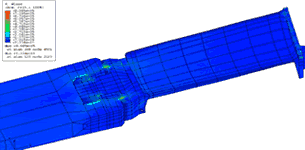
Figure 1.
- Tensions and frequency of vibrations of its own rotor consisting of 144 blades of length L = 0.1203 [m],15 degree turbine 13UC105 for ALSTOM POWER Polska, 2002, (Figures 2, 3).
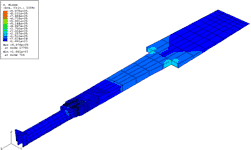
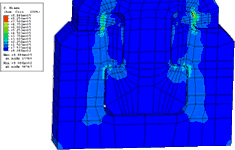
Figure 2. Figure 3.
- Tensions and vibration frequencies of the own rotor consisting of 144 blades with length L = 0.1341 [m],16 degree turbine 3UC100 for ALSTOM POWER Polska, 2003.
- Calculation of 3D non-stationary turbine forces for rotating and vibrating blades with unsymmetrical pressure distribution behind rotor blades due to a reduction in 16 degree turbine13UC100 for ALSTOM POWER Polska, 2003.
II. Aerosastic calculation
1. Calculation of 2D and 3D flutter of twisted blades:
Two- and three-dimensional numerical simulations were carried out based on the time step method to investigate the aerosastic phenomena occurring in the interplated ducts, including shoulder vibrations. A mechanical-flow coupled issue was solved in which aerodynamics and structural mechanics equations are integrated simultaneously over time. With this wording, the coupled phase shift angle between blades for which stability (or instability) occurs is part of the solution. The flow of perfect gas through the palisade channels (with periodicality throughout the circuit) is described by the non-stationary Euler equations in a conservative form, which are integrated on a hybrid H-H (or H-O) type grid using the open, monotonous Godunov-Kolgan diagram of the second order of accuracy. The design motion analysis is based on modal analysis and 3D blade model (MES). It is assumed that blade movement is a linear combination of modal characters with time dependent factors.
2. 3D non-stationary forces operating to a degree with vibrating and rotating rotor blades in subsonic, transonic and supersonic slow flow.
The theoretical model and numerical calculations of 3D transonic flow of ideal gas through channels formed from vibrating turbine blades developed The approximate solution is based on the solution of the coupled aerodynamic-constructive issue for 3D flow through the turbine degree, in which the fluid movement equations and structures are integrated simultaneously over time, making blades vibrations in flow and non-stationary forces on them part of the solution. The flow of perfect gas through mutually shifting steering and rotor blades is described by the non-stationary Euler equations, which are integrated using the open, monotonous Godunov-Kolgan scheme on the mobile H-H grid. A modal and 3D blade model (MES) is used in the analysis of the movement of blades. The movement of the shoulder is a linear combination of the first forms of vibrations of the own shoulder with modal factors dependent on time. The proposed algorithm allows to calculate non-stationary blades forces in turbine stages with any scale for steering and rotor blades including vane vibrations taking into account uneven speed fields behind rotor blades.